
Climate-Controlled Storage for Client Pieces: A Designer's Checklist
Most damage to client pieces does not happen during the move. It happens in storage. Picture a sofa that survives a cross-country delivery. After six weeks in an unregulated unit, it can develop mold, warped legs, or fabric discoloration. By the time it arrives on install day, the damage is already done.
This checklist is for interior designers managing furniture and fine furnishings between projects. Save it. Print it. Run it before anything goes into storage.
Why Storage Is the Invisible Risk
For designers, the stakes are higher than for a typical homeowner. You are responsible for pieces you did not buy, often for clients who paid a premium for them.
One incident can undo years of trust. Warped veneer on a vintage credenza. Mildew on a custom upholstered chair. Cracked lacquer on a cabinet. Any of these can damage your reputation, your vendor relationships, and your client's confidence. And the damage is hard to reverse.
The fix is not complicated. It starts with knowing what Climate-Controlled Storage actually provides, and what it does not. Make the right call before a piece ever leaves the Receiving Warehouse.
If you manage renovation projects, the risk compounds. Furniture sits longer during active construction, often in facilities chosen by the contractor rather than by you. Those facilities are rarely selected with your inventory in mind. Our Renovation Storage Services protect client pieces during active construction, remodeling, and phased installations.
Key Takeaways
- Climate-controlled storage means a stable 65-72°F and 45-55% relative humidity, monitored and logged continuously
- Every piece should get a photo and written condition report before it goes into storage
- Confirm insurance coverage and replacement value terms before storage begins, not after
- Acclimation before install typically takes at least 24 hours
- Request a quote and we'll confirm timeline and next steps within 24 hours
What "Climate-Controlled" Actually Means
.jpg)
The industry benchmark for fine furnishings and fine art storage is 65 to 72°F, with relative humidity between 45 and 55%. The humidity number matters more than most designers realize.
Wood expands and contracts with moisture. Veneer separates. Upholstery fabrics absorb ambient moisture. They can become a breeding ground for mildew. Antique finishes crack.
For designers managing high-value projects, the goal is simple: keep client pieces stable, documented, and install-ready.
What to look for:
- Dedicated HVAC systems, not shared with office or public areas
- Continuous humidity monitoring with documented daily logs
- Backup generator or redundant climate systems
- Sealed building envelope that prevents outdoor air intrusion
- Pest control program and fire suppression systems
In coastal markets like Southwest Florida, the stakes are even higher. For Florida projects, see how William C. Huff's Hurricane Storage Services combine protection, climate control, pickup, and restaging into one storm-season plan.
The Pre-Storage Checklist
Run through this before any client piece enters storage.
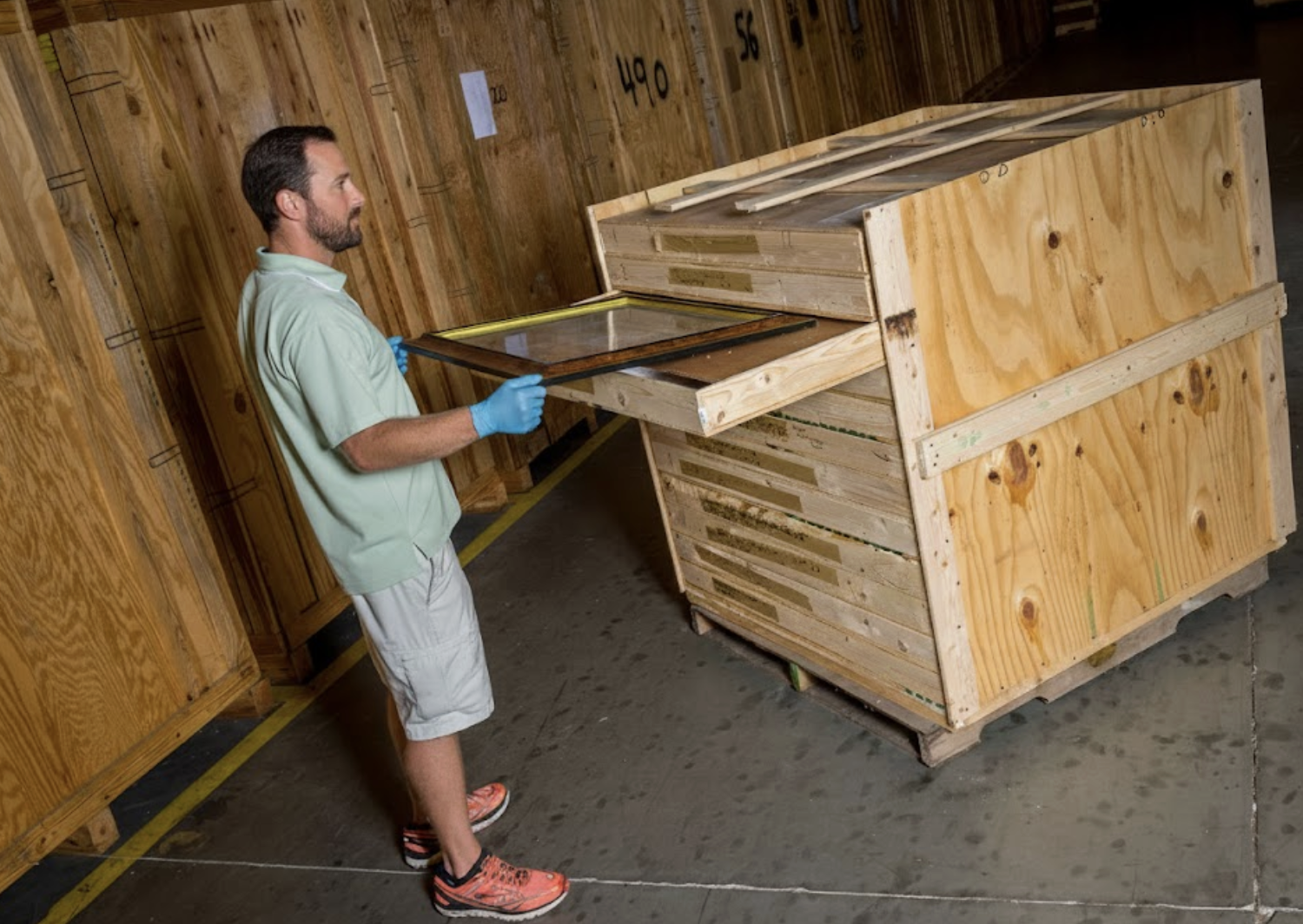
- Photograph every piece under good light, all angles. Include close-ups of existing scuffs, hardware, fabric seams, and leg bottoms. This is your baseline for any future claim.
- Complete a written condition report. Note existing wear, repairs, structural issues, or manufacturer quirks. Sign and date it. Ask the storage partner to co-sign at intake.
- Confirm the facility's climate specs in writing. Ask for documented temperature and humidity ranges, not verbal assurances. The benchmark is 65 to 72°F and 45 to 55% RH.
- Verify the facility has backup climate systems. Power interruptions happen. A facility without a generator or redundant HVAC cannot guarantee its specs.
- Confirm insurance coverage for each piece. Check whether your client's policy, your business policy, or the storage partner's policy covers the pieces. Confirm the value type. Replacement value protects you more than depreciated value for client-grade furnishings.
- Use the correct packaging for each material type. Breathable covers for upholstery. Acid-free wrap for gilded or lacquered surfaces. Clean felt blankets for wood and metal. Plastic sheeting traps moisture against porous materials, so avoid it.
- Disassemble only if necessary, and document it. Photograph the hardware. Label every component. Bag screws and bolts with the piece. Reassembly errors at install happen more often than they should.
- Log each piece in your project inventory system. Include the facility location, intake date, expected release date, and condition at intake. Update the log when anything changes.
- Request a chain-of-custody record from the storage partner. Every handler who touches the piece should be logged. This matters when you need to trace a claim.
If you work with a receiving partner, ask whether condition photography and co-signed reports are part of their standard intake. William C. Huff offers two services for this: Residential Designers and Commercial Designers. Choose the one that matches your project.
5 Questions to Ask Any Storage Partner
Do not rely on the phrase "climate-controlled" in a brochure. Ask these directly.
.jpg)
A professional facility will give you a written answer: specific ranges, monitoring equipment, and logged records you can request. Vague answers are a red flag. "We keep it cool and dry" is not an answer.
Ask about backup generators, battery-maintained HVAC, and their documented response protocol. A single overnight outage in a humid climate can cause damage that takes months to appear.
This protects both parties. If the answer is no, build your own intake process and insist on documentation before the piece is accepted. A professional receiving partner documents everything from intake to final delivery without making you chase it down.
Most standard storage insurance covers items at depreciated value. That is not enough for client-grade pieces. Confirm the per-item limit and whether coverage is included or costs extra. See our Licensing and Insurance Overview for what a professional operation carries.
Look for a barcode or RFID inventory system, documented chain-of-custody records, and the ability to pull a condition log for any piece. If inventory management is informal, tracing a problem later is almost impossible.
From Storage to Install Day
The storage period is only half the equation. How a piece comes out of storage matters as much as how it went in.
Allow at least 24 hours for pieces to acclimate before uncrating. This matters most for wood furniture moving from a controlled space into a newly built or freshly painted room, where temperature and humidity are still settling. Rushing this is a leading cause of post-install warping and finish issues.
Perform an arrival condition check against your pre-storage documentation before the client sees the pieces. Compare photographs, note any changes, and file any claims immediately. Most policies have strict filing windows that start at delivery, not at discovery.
Our Elite Designer Services coordinate everything from receiving to storage to final install. One point of contact, one timeline. For a deeper look at how these workflows connect, read our Complete Guide to Fine Art Moving and Logistics.
Frequently Asked Questions
The standard for furniture and fine furnishings is 65 to 72°F with relative humidity between 45 and 55%. Rapid swings in either direction cause more damage than a sustained level slightly outside the ideal range. Consistency is the priority.
Not every piece carries the same risk. Solid metal and stone tolerate wider ranges. Antiques, upholstered pieces, lacquered or gilded furniture, veneer, works on paper, and anything with inlay are high-risk in uncontrolled environments. When in doubt, climate control is the safer default for any client-grade piece.
Indefinitely, provided conditions are properly maintained. The risk is not the length of time in storage. The risk is environmental instability. A well-managed climate-controlled facility can hold pieces safely for months or years.
Standard storage units are typically uninsulated and unregulated. Temperature can swing wildly with the seasons. Climate-Controlled Storage keeps temperature and humidity stable year-round through active HVAC systems. That stability prevents the moisture and heat cycles that warp wood, crack finishes, and degrade fabric.
Always get one. A pre-storage condition report with photographs establishes a clear baseline. Without it, you cannot prove whether damage happened before intake or during storage. That matters for insurance claims. That matters for client trust. Make it part of your intake process, every time.
Protect Client Pieces Before Install Day
William C. Huff provides White Glove Moving, Climate-Controlled Storage, Hurricane Storage, Antique Transportation, Designer Receiving, Inspection, and Installation support across Florida and New England.
To discuss storage for an upcoming design project, call our team or request a free quote.
.jpg)